An Ongoing Exploration into the Many Worlds of Early 20th-Century Escapist Literature

An Ongoing Exploration into the Many Worlds of Early 20th-Century Escapist Literature -- Crime and Adventure, Fantasy and Science-Fiction, Horror and Weird
Showing posts with label Megalomania. Show all posts

Sunday, October 27, 2013

"The Most Dangerous Game" -- Richard Connell (COLLIER'S WEEKLY, January 19, 1924)

I was so excited to see this story come up next in The Big Book of Adventure Stories, readers.  I've seen at least six different film adaptations, ranging from the serious 1932 film, starring Joel McCrea, Fay Wray and Robert Armstrong (and which was shot at night on the same sets Wray and Armstrong were on by day shooting KING KONG!) to the cheesy 1980s sci-fi bimbo-rama SLAVE GIRLS FROM BEYOND INFINITY starring Brinke Stevens, and which was once famously condemned on the Senate floor by Jesse Helms.  And of course, by 2013, the theme of a wealthy man hunting other men for sport has become almost cliche.  I was excited to see how the original short story held up compared to the various adaptations and takes on the theme I'd seen, and let me tell you, Richard Connell's prose did not disappoint.

Sanger Rainsford, a prominent big game hunter from New York, is sailing to Rio de Janeiro with his friend Whitney in order to hunt jaguars.  One dark night, the two men are sitting on deck and find themselves discussing the upcoming hunt, with Whitney pondering what the jaguars must think of it.  Rainsford scoffs at this line of thought, and Whitney retires to bed.  Rainsford stays on deck smoking his pipe, until startled by a trio of pistol shots echoing from nearby Ship-Trap Island, causing him to drop his pipe.  Fumbling for it in the dark, he falls overboard, and when he realizes he can't swim fast enough to catch back up to the ship, makes for Ship-Trap Island.

On the island, Rainsford is stunned to discover an elegant chateau, and soon learns that the island is home to a pair of Cossacks (an ethnic group that's strangely become a theme around here...) -- the aristocratic General Zaroff and his deaf-mute servant, Ivan.  Zaroff is a big game hunter as well, and in fact is a great admirer of Rainsford's books on hunting.

Over dinner, Zaroff explains to Rainsford how over many years, he's grown bored with hunting, and finds no thrill in hunting big game animals any more -- but has found a new prey, "the most dangerous game." On Ship-Trap Island, Zaroff lures ships aground and hunts the people he captures from these wrecks for sport.  He asks Rainsford to join him in a hunt, and when Rainsford, appalled, refuses, Zaroff decides to hunt him instead.

Given a few hours' head start, Rainsford must survive three days without being shot by Zaroff or torn to bits by either Ivan or Zaroff's pack of hunting dogs.  If, at the end of three days, Rainsford is still alive, Zaroff pledges to put him safely ashore on the mainland with no ill will.  It will take all of Rainsford's cunning and intellect to survive...

"The Most Dangerous Game" is a brilliant exercise in "less is more."  The story doesn't quite fill nine pages in The Big Book of Adventure Stories (ten including the introduction), but doesn't need more than that to tell itself.  The writing is as lean and wolfish as Zaroff himself, unfettered with purple prose.

This sparseness of story-telling may be a turn-off to modern readers; it's a tale of suspense and tension, not of violence and blood-letting, and I think if readers come in expecting a battle royale they'll be deeply disappointed.  The emphasis is on the fraying of Rainsford's nerves as he struggles to survive in the face of Zaroff, an almost supernaturally-talented hunter, and his efforts to maintain a strong enough control of himself to fight back.

In fact, so little emphasis in the story is on violence that the finally conflict between Zaroff and Rainsford doesn't even take place "on screen" as it were; the second-to-last paragraph ends with Zaroff accepting Rainsford's offer of a man-to-man fight, while the last paragraph, only a sentence long, describes Rainsford settling in to rest up and recuperate after his ordeal.  The fight is left entirely to the reader's imagination, which is a bold move that I don't think would fly today.


Saturday, October 26, 2013

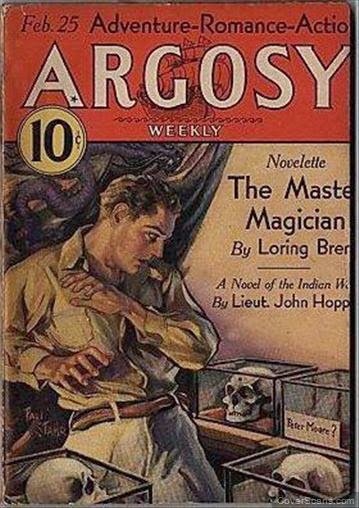
"The Master Magician" -- Loring Brent (ARGOSY, February 25th, 1933) PART 2

I kind of feel like a chump now for splitting this story into two nights of reading and two blog-posts.  When I got into bed and started reading last night, I discovered that the remainder of "The Master Magician" took me no more than 20 minutes to devour.  I probably could have sat up and finished the story all in one go the night before if I'd but realized.  Oh well.

To recap where we left our hero Peter Moore last time, Moore and his friend Roger Pennekamp have realized that an old enemy, the magician and would-be dictator Zarlo, has returned to exact revenge on them for deposing him in the Philippines six years earlier.  With the three men who'd aided them already dead and several attempts made on Pennekamp's life, Moore and Pennekamp resolve to take the fight to Zarlo, wherever he may be holed up.  This resolve is strengthened when Moore's traveling companion, the thrill-seeking heiress Susan O'Gilvie, is kidnapped to lure Moore into Zarlo's clutches.  An impromptu seance, at Pennekamp's insistence, suggests the island of Soononga, more commonly known as Skull Island, is the site of Zarlo's hideout.

Traveling to Soononga, Pennekamp's ship is stormed by a boarding party of black pirates (my guess being that these aren't blacks of African descent, but rather dark-skinned Polynesians, given the location) and Moore is taken captive, along with sniveling American wimp Jason Whitelaw, who has come along in hopes of convincing Susan that he loves her and she'll hopefully love him back.

Brought before Zarlo, Moore is given a glimpse of the possible fates that await him -- the skulls of the three men who'd preceded him in dying at Zarlo's hand are on display with neatly-lettered placards describing who they were and how they died, and more ominously, Zarlo shows Moore "Ronga" -- a former American business man, regressed to a snarling, mindless beast by Zarlo's magic, more than eager to feast on raw human flesh.  Zarlo assures Moore that should Moore make any attempt to escape, Ronga will follow him like the best-trained of bloodhounds.

Before long, of course, Moore breaks free and, with Whitelaw showing what he's made of for a change, sets off to rescue Susan and give Zarlo a taste of his own mad medicine...

Wow, what a story! Action, adventure, romance, exotic locales, mysticism, monsters (one made from a human being, no less!), betrayal, and so much more crammed into so few pages, I can say in all honesty that "The Master Magician" is a story that grabs the reader by the lapels and doesn't let go until the ink's dry on the last punctuation mark.

The characters are rich and interesting, and nothing about them feels forced or unnatural.  From Susan's headstrong conviction that whichever possibility offers the most excitement must be the truth to Peter's horrified ruminations on what would happen if he, a man who just wants some peace and quiet, were to marry Susan, these all feel like real people.

I also liked Brent's committal to remaining non-committal on the subject of the occult, carefully presenting every seemingly-supernatural event as one that has a rational explanation...but maintaining an open-mindedness towards the notion that that explanation might not be the "correct" one.  Sure, it's likely that Zarlo kept Ronga an animal through keeping him drugged and under hypnotic suggestion...but maybe, just maybe, he did use his mystical powers to drive a man's soul out of his body, leaving only a brutal monster behind.

This story really slapped me upside the head and took me by surprise, and I'll say no more about it other than to advocate you really check it out.


Friday, October 25, 2013

"The Master Magician" -- Loring Brent (ARGOSY, February 25, 1933), PART 1

Here we are again, with another story - another that will be covered in installments here at BPaLGM - from The Big Book of Adventure Stories.  We've entered the section entitled "Megalomania Rules," and with it a world of madmen, masterminds and maniacs bent on proving their own superiority and lording it over the common man.  Such figures were a common trope of the pulps, including such noteworthy villains as Fu Manchu, Shiwan Khan, John Sunlight and many others.  This first story, "The Master Magician," is from author Loring Brent (real name: George F. Worts), and forms part of a series detailing the ongoing adventures of a man named Peter Moore, aka "Peter the Brazen," a wireless radio operator working the various freighters and cruisers around Chinese and South-East Asian waters, who finds himself again and again drawn into conflicts well above his pay-grade.

"The Master Magician" finds Moore lying low in Hong Kong, hoping to escape some heat from certain unsavory figures who'd like to see him floating face down in the harbor.  Unfortunately, stepping out for a breath of fresh air, Moore runs into trouble, when a figure in the dark hands him a tiny, tightly-folded piece of red rice paper.  Moore needs only glance at the writing on it - pictographs, really, five tiny stick figures, the three leftmost checked off - to know exactly what it means.

Bringing along his thrill-seeking socialite companion Susan O'Gilvie, Moore finds his way to the yacht of his old friend, Roger Pennekamp, who has, it turns out, come to Hong Kong in search of Moore -- Pennekamp had received a square of red rice paper marked with five stick figures as well, and has experienced three failed attempts on his life in recent months.

Putting their heads together, Pennekamp and Moore quickly figure out exactly who's gunning for them: Zarlo, a persuasive and sinister figure who'd set himself up as the power behind the throne in the Sultanate of Tuzpan in the Philippines years earlier, only to be swiftly deposed by Moore, Pennekamp, and three other men.

Though they'd only intended to throw him out of Tuzpan, the intervention of Moore and Co. earned Zarlo a savage beating from the locals, leaving the con-man near death and swearing revenge.  Moore realizes Zarlo's revenge is at hand -- the three other men who'd gone with him and Pennekamp to depose Zarlo having already been killed, and Pennekamp clearly the next target.

That night, Susan O'Gilvie is kidnapped out from under Moore and Pennekamp's noses by a group of Chinese sailors on an unmarked gray launch, slipping away with the wealthy heiress under cover of darkness.  Pennekamp, a strong believer in the occult, suggests an unusual means of finding where she's being taken; consulting a crystal ball he keeps with him.

Moore forces his misgivings about the crystal aside and the two men, plus Jason Whitelaw, a sadsack suitor of Susan's, turn down the lights, sit around a table and focus on the crystal -- and see a vision! The crystal reveals an island whose headland resembles a fleshless human skull, and from the vision Moore is able to identify the island -- Soononga, south of Borneo, more commonly known to mariners as "Skull Island."

So far, I'm enjoying "The Master Magician."  I feel like the story began right on the cusp between "before the action" and "in media res," balancing on a razor's edge of tension between "nothing has happened yet" and "everything is happening."  I also like that we have Moore acting on information that the reader is not privy to until it's explained to O'Gilvie, who for a span takes on the role of audience surrogate; sort of a Dr. Watson character, she's there in the meeting between Moore and Pennekamp to give them a reason to explain who Zarlo is and why he's trying to kill them.  Now that she's been kidnapped and Jason Whitelaw has joined Moore and Pennekamp to effect her rescue, I imagine he'll be taking her place for any such similar scenes of exposition later in the story.

The thing that really took me by surprise, at least briefly, was the locale of "Skull Island."  The issue of Argosy containing "The Master Magician" hit newsstands just five days before KING KONG had it's initial premiere (at RKO Musical Hall in New York City).  It would seem like just one of those bizarre coincidences that sometimes occurs, though islands with skull-shaped mountains on them do have something of a history in adventure stories, dating back (at the very least) to 1881 with Stevenson's Treasure Island.

This post covers the first four chapters of the story, and I'm looking forward to getting some more reading in tonight.